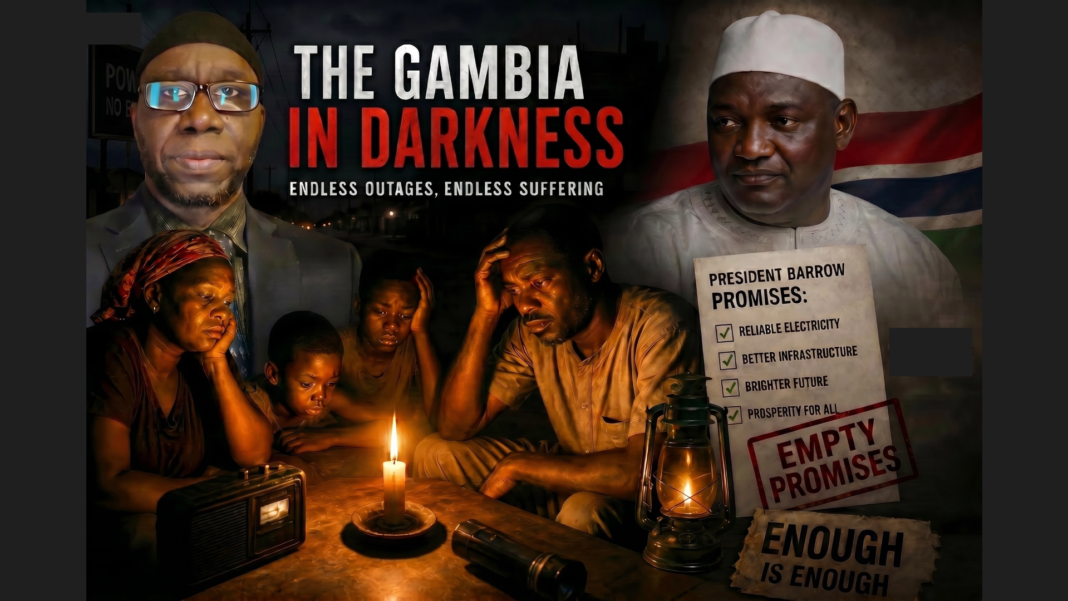
For years Gambians have suffered from repeated power cuts, broken appliances, stalled businesses and sleepless nights, all while being told that help is on the way. But despite millions of dollars spent, donor-funded projects and repeated government pledges, the country’s electricity problem continues to be a daily reality.
The continued failure of the Adama Barrow administration and the National Water and Electricity Company (NAWEC) to provide reliable electricity has become one of the most glaring cases of poor governance and institutional mismanagement in modern Gambian history.
Electricity is not a luxury. It is the foundation of economic growth, health care, education and industrial development. No country can aspire to meaningful progress while its citizens and businesses remain uncertain whether the lights will stay on. Yet after nearly a decade in office, the Barrow administration continues to struggle with a problem that should have been among its highest priorities.
The government’s response has often been one of excuses rather than solutions. When widespread outages occur, officials blame technical faults, regional power challenges, fuel costs or transmission issues. While these factors may contribute to disruptions, they do not explain why electricity shortages continue to plague The Gambia while neighboring countries maintain relatively more stable supplies. At some point, responsibility must lie with those tasked with managing the sector.
NAWEC, as the country’s sole electricity provider, has run without meaningful competition for decades. As a monopoly, however, the utility is forced to respond to accusations of poor planning, poor financial management and poor maintenance of key infrastructure. Reports of rising debts owed to energy suppliers have only heightened public concerns about the sustainability and transparency of the institution.
The consequences of this failure are widespread. Power cuts also cause revenue losses for small businesses. Students preparing for examinations find it difficult to study. Hospitals and health facilities find it difficult to operate. An unreliable power supply discourages investors who want to set up industries in The Gambia. Ultimately, it is ordinary citizens who pay the price in economic losses, damaged equipment and increased cost of living.
Even more troubling is the possibility that consumers will once again be asked to pay for these failures through higher electricity tariffs. It would be a gross injustice to ask citizens to pay more for poor quality services. Gambians deserve accountability before they are asked to pay more.
The Barrow administration came to power promising reform, efficiency and better public services. But on electricity, the results have fallen far short of expectations. Gambians do not need another promise or a public relations campaign. What Gambians need now is a comprehensive plan with transparency, accountability and measurable results.
Until then, the country’s electricity crisis will remain a potent symbol of a government and utility company that have failed to deliver on one of their most basic responsibilities to the people.
By Salieu Njie