
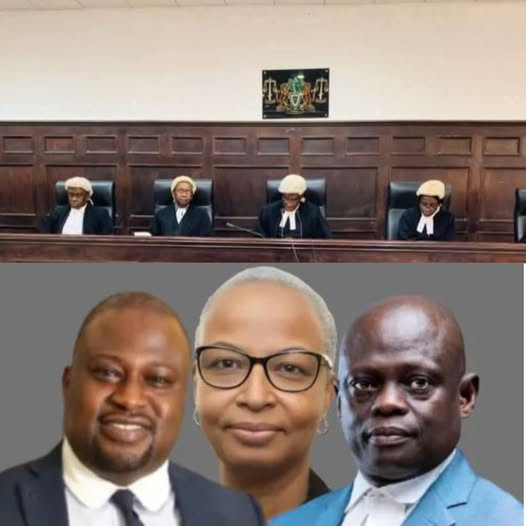
The Supreme Court of The Gambia has become the epicentre of constitutional debate by three Counsel as it prepares to deliver a judgement on the lawsuit filed by former Auditor General Modou Ceesay against the Ministry of Justice and the Inspector General of Police.
In the final submissions, Counsel for the Plaintiff, the State, and an Amicus Curiae presented legal arguments that will determine the future of independent oversight and the security of tenure for public officials.
At the heart of the matter is whether former Auditor General Modou Ceesay was “forcefully and unlawfully removed” from his office by the police, or whether he voluntarily ceased to hold office by accepting a presidential appointment as a Cabinet Minister.
Representing the former Auditor General, Counsel Lamin J. Darboe first took the floor standing before a five-judge panel, Counsel Darboe argued that the office of the Auditor General is “ring-fenced” and “insulated from external control” to ensure national transparency, yet was subjected to “arbitrary power” by the executive branch.
Counsel Lamin J. Darboe characterises his client’s removal as a “frontal assault on the rule of law” and a calculated stop to sensitive government audits.
Counsel Darboe argued that Modou Ceesay’s sudden ousting was not a professional promotion to a ministerial role, but an unlawful eviction from the national audit office meant to protect the country’s transparency.
Counsel Darboe emphasised the legal sensitivity of the Auditor General’s position. He argued that under Sections 158, 159, 160, and 169 of the Constitution and Section 16(4) of the National Audit Office Act 2015, the office is insulated from arbitrary executive power.
Darboe reminded the justices that the law allows for the removal of an Auditor General under only two strict conditions; inability to perform due to infirmity of mind or body, which requires a report from a properly constituted Medical Board and misbehavior or incompetence, which requires the President to appoint a Tribunal chaired by a High Court Judge and including the Ombudsman, a member of the Public Service Commission, and a Chartered Accountant.
“There was neither a Medical Board nor a Tribunal appointed to look into the affairs of the Plaintiff when it was decided to remove him,” Darboe asserted, noting that Ceesay was not removed for any of the legal grounds.
Counsel J Darboe contended that the offer of a ministerial role on September 10, 2025, was out of Modou Ceesay’s refusal to halt sensitive audits. Counsel J Darboe stated that Ceesay claims the President personally urged him to stop or delay the audit of the National Food Security and Processing and Marketing Company; the audit in the
Ministry of Lands on the state land allocations which allegedly met with pressure from the President and the Minister of Finance to delay until a new land policy was approved.
Also, GRA revenues, Modou Ceesay faced deliberate refusal from the Gambia Revenue Authority to provide database backups, a refusal he claims the President echoed and the Audits involving a 1.2 billion Dalasi payment to the government which allegedly raised serious concerns at the Presidency.
Addressing the State’s claim that Modou Ceesay accepted a new role, Counsel Darboe was direct “The Plaintiff at no time accepted his proposed appointment as Minister verbally or in writing,”. According to Darboe, the Auditor General’s office is “insulated from external control” under Sections 158, 159, 160, and 169 of the Constitution.
Counsel J Darboe pointed to an administrative blunder of the purported appointment letter (Exhibit P1A) indicating it was addressed to an internal audit director rather than the Auditor General. Furthermore, Exhibit P1B explicitly required a written acknowledgement and acceptance of terms but Counsel Darboe notes that never occurred. Instead, Modou Ceesay sent a formal letter on September 11, 2025, respectfully declining the offer.
Counsel Darboe also detailed what he describes as “intense lobbying” that followed, including a 40-minute meeting where Minister of Finance Seedy Keita allegedly pressured Modou Ceesay to accept the role to avoid his position becoming untenable.
Counsel Darboe argued that when Ceesay refused to vacate his office, the President utilised the Gambia Police Force to “barbarically remove” him from the office.
Counsel Darboe contended that the State admitted to the forceful removal in their own defence, justifying the police intervention by claiming Modou Ceesay was a “trespasser” who had “no right to be in the said office” once a successor was named.
To support his argument, Counsel Darboe cited the Supreme Court’s own decision in Ya Kumba Jaiteh v. Clerk of the National Assembly, noting the court should be hesitant to imply powers for the executive that disadvantage the citizenry. He also cited Ghanaian case law, arguing that the Auditor General must be “strengthened and kept free from the “control or direction of any person or authority.
Counsel Darboe concluded by praying for the court to declare the removal unlawful and unconstitutional, restoring the constitutional protections of the office and reversing what he called a frontal assault on the rule of law.
In a rebuttal, veteran Counsel Ida Drammeh, representing the Attorney General and the Inspector General of Police, argued that the lawsuit brought by former Auditor General Modou Ceesay is legally fundamentally flawed and unsupported by evidence. Counsel I. Drammeh argued that Modou Ceesay ceased to be the Auditor General the moment he accepted the new role.
Senior Counsel Drammeh asserted that Modou Ceesay’s transition from Auditor General to a Cabinet Minister was a voluntary discontinuation of office, not the forceful removal as in his writ of summons.
Counsel Drammeh’s argument hinged on the legal principle that parties are bound by their pleadings. She cited the landmark case of Southport Corporation (1956) and the Nigerian Supreme Court decision in Ramonu Rufai Apena v. Oba Fatai Aileru (2014) to remind the bench that “no party will be allowed to set up a case other than that which is captured in his statement of claim.
Counsel Drammeh pointed out that while the Plaintiff’s case “morphed” into a constitutional debate during the trial, his original pleading in Paragraph 27 alleged a physical removal by the Gambia Police Force on instructions from the President.
“The fairness of a trial can be tested by the maxim audi alteram partem,” she argued, citing George v. Dominion Flour Mills Ltd (1963), stressing that the State cannot be expected to defend against “the unknown” when the evidence led by the Plaintiff failed to support the specific allegation of forceful eviction.
The Constitutional Shift: Section 71 vs. Section 158
Counsel I. Drammeh separated the legal requirements for “removal” from those of “appointment.” Drammeh argued that this was never a case of termination under Section 158 of the 1997 Constitution which governs the removal of an Auditor General for misconduct or incapacity.
Counsel Drammeh highlighted the timeline based on admitted facts; she stated that on September 10, 2025, the President issued an “Appointment to the Office of Minister” under Sections 71(1) and 71(3) of the Constitution (Exhibit P1a). The Plaintiff thanked the President, requested a second meeting, and received congratulations.
Counsel Drammeh cited Section 229(2) of the Constitution, arguing that since the Plaintiff accepted the ministerial role and a successor (Cherno Amadou Sowe) was identified and announced via a State House media release (Exhibit P5), Modou Ceesay legally ceased to be the Auditor General.
“He was not removed from office, but rather ceased to be Auditor General after his appointment,” Drammeh told the justices, noting that the letter of appointment was never returned to the President.
Addressing the Plaintiff’s claims that the State violated Sections 3(2), 11, 13, 14, and 16 of the National Audit Office Act 2015, Counsel Drammeh invoked Sections 141 and 143 of the Evidence Act. She argued that the burden of proof rests squarely on the person who would fail if no evidence were given.
Counsel Drammeh contended that the Plaintiff failed to provide a shred of evidence neither oral testimony nor documentation to prove that the Attorney General (1st Defendant) or the IGP (2nd Defendant) entered the premises to forcefully remove him.
Counsel Drammeh noted that even the Plaintiff’s own testimony admitted he was asked to leave and he left, which does not constitute a forceful removal in the eyes of the law.
Counsel Drammeh highlighted that by September 15, 2025, the Plaintiff had no legal right to occupy the National Audit Office or call press conferences therein. She argued that Modou Ceesay’s refusal to vacate prevented the newly appointed Auditor General, Cherno Amadou Sowe, from performing his statutory duties.
Citing Phipson on Evidence and Halsbury’s Laws of England, Counsel Drammeh stated that the facts in issue had not been proven by the Plaintiff.
Counsel Drammeh concluded her submission by stating that no evidence exists to prove that the 1st or 2nd Defendants (the Attorney General and IGP) caused a forceful removal. She argued that with the laws cited and facts established, the Supreme Court cannot grant the prayers sought by the Plaintiff.
“This is not a case of termination by the President at all,” She urged the five-panel bench to dismiss the claims (Prayers 1 and 4), asserting that granting the relief sought would be a violation of the very legal and constitutional principles the Plaintiff claims to uphold; urging the court to dismiss the claims and recognize the validity of the transition from Auditor General to Minister.
Counsel Drammeh stated, leaving the five-panel bench to deliberate on a judgment that will impact the interpretation of executive appointments and the tenure of independent constitutional officers.
Adding a broader constitutional debate or perspective, Counsel A. Fatty, appearing as Amicus Curiae (friend of the court), urged the justices (Judges) to view the case through the lens of democratic preservation.
Counsel Fatty argued that the office of the Auditor General is uniquely protected, stating that under current law, removing a judge is easier than removing an Auditor General due to the multiple layers of protection involved.
Addressing the court in the ongoing lawsuit filed by former Auditor General Modou Ceesay against the Attorney General and the Inspector General of Police, Counsel Fatty urged the bench to reinforce democratic principles and the “ring-fenced” independence of the National Audit Office (NAO).
Counsel Fatty argued on the statutory guarantees provided by the National Audit Office Act 2015. He informed the justices that Section 3 of the Act explicitly guarantees the office’s existence and independence, while Section 14 creates a secure environment for the Auditor General to function without fear.
“The law has provided protection for the Auditor,” Fatty argued, noting that the office is protected by multiple layers of legal barriers. He asserted that any removal must strictly follow the stipulations laid down in the Constitution and the governing Act, or it constitutes an unlawful act.
Counsel Fatty argued on the procedural timeline for vacating the office. Citing Section 16(3) of the National Audit Office Act, he pointed out that even in cases of resignation, the Auditor General is required to give thirty days’ notice in writing to the President.
Counsel Fatty argued that the provision makes the State’s claim of a transition impossible. “Suppose the Plaintiff even accepted the appointment or resigned, the law states a 30-day notice period,” he contended. Adding that the State could not legally appoint a new Auditor General within two days, as the law mandates a notice period before a vacancy can be officially filled and a successor appointed.
Counsel Fatty highlighted that the office of the Auditor General is ring-fenced and insulated from external control due to its role in ensuring public transparency. He invoked Sections 158, 159, 160, and 169 of the Constitution, emphasising that the President’s power of termination is expressly constrained.
Counsel Fatty argued that removal can only occur under Section 158(5) for inability to perform or misbehaviour/incompetence and the conditions require a medical board report for physical or mental infirmity or a tribunal chaired by a High Court Judge for cases of incompetence or misbehaviour.
Counsel Fatty noted that since neither a Medical Board nor a Tribunal was established, the forceful removal of Modou Ceesay was a direct violation of the constitutional safeguards.
Referencing the landmark Supreme Court judgment in Ya Kumba Jaiteh v. The Attorney General, Counsel Fatty cited page 36 of the decision to support the need for the court to check arbitrary executive power. He also drew on a Nigerian case to illustrate the legal standards for resignation in public service.
Counsel Fatty emphasised that the issue before the court is not merely whether Modou Ceesay accepted a ministerial role, but whether the strict requirements of the law were met.
Counsel Fatty pointed to Section 222 of the Constitution and Section 59 of the Act to argue that the court must protect the republic and its people by enforcing the rule of law.
“The office of the Auditor General needs protection,” Fatty concluded, “and the court should reinforce our democratic principles” by declaring the removal unlawful.
The Supreme Court has adjourned the matter for judgment and the Judgement will be communicated.