
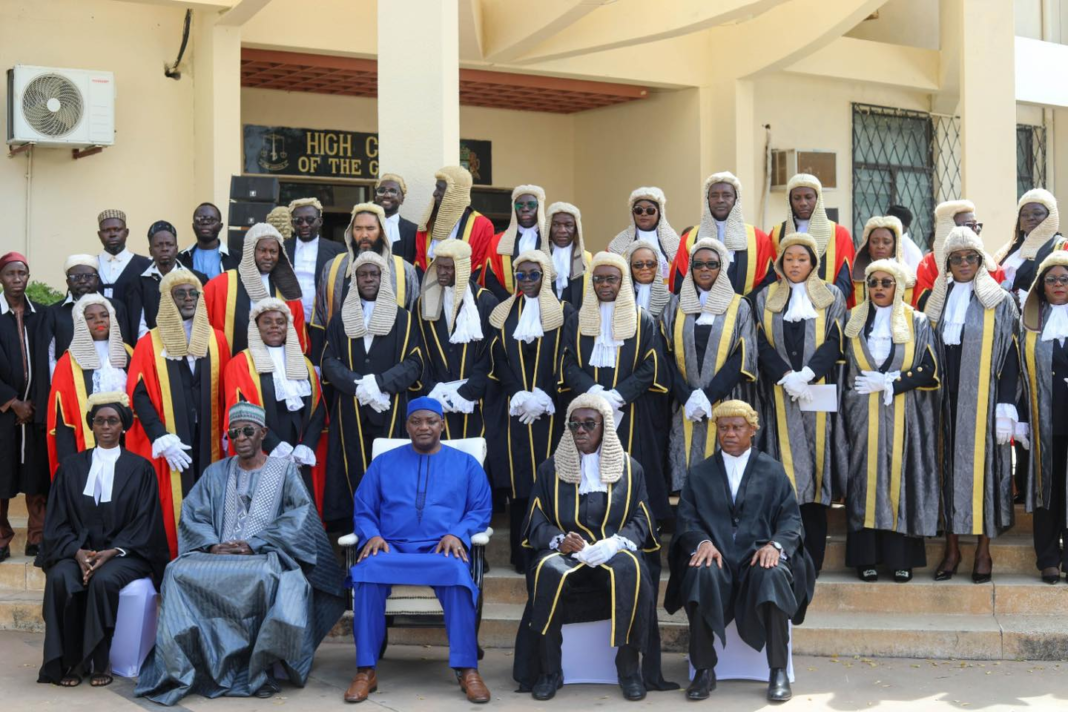
Using the launch of The Gambia’s 2026 Legal Year to lay out plans for judicial reform, accountability for historical abuses, and the ongoing modernization of the justice system, President Adama Barrow on Sunday underlined his government’s commitment to bolstering the nation’s legal institutions.
During a ceremony held at the Banjul High Court, Mr. Barrow stated that democratic governance, peace, and economic growth all depend on an independent and effective judiciary. He also promised continued government support to allow courts and related institutions to carry out their constitutional duties.
He stated that “the administration of justice remains a cornerstone of our democracy” and that “peace, stability, good governance, and sustainable development” depended on a robust judiciary.
The president highlighted advancements made under the Judiciary Sector Strategic Plan, including measures to strengthen judicial independence, increased access to justice, and enhanced case management. He cited the digitization of court procedures as a significant development, describing it as a “transformative endeavor” that would increase the judicial system’s overall effectiveness and transparency.
Additionally, Mr. Barrow discussed initiatives to hold those responsible for human rights abuses from July 1994 to January 2017 accountable. He declared that the government had passed the Special Accountability Mechanism Act and the Special Prosecutor’s Office Act, which made it possible to appoint a special prosecutor to handle cases related to that time period.
As a crucial part of the nation’s larger reconciliation effort, he stated a Special Division of the High Court would also be created. He stated, “It reflects our collective resolve to confront past acts of injustice while building a future grounded in truth and the rule of law.”
On the global scene, Mr. Barrow emphasized The Gambia’s involvement in the International Court of Justice case against Myanmar for alleged crimes against the Rohingya people. He said the case had established The Gambia as “a principled defender of justice internationally,” and he hoped for a positive result. He also mentioned the nation’s endorsement of a UN General Assembly resolution requesting a court advisory opinion about governments’ responsibilities to combat climate change.
Regarding internal governance, the president declared that the fight against corruption was being stepped up and that the Anti-Corruption Commission’s appointments were anticipated to be finalized shortly. Additionally, he mentioned the creation of an all-encompassing Justice Sector Policy, backed by the EU, which he claimed would act as a guide for further change.
In a more pragmatic show of support for the judiciary, Mr. Barrow revealed that he had personally authorized the replacement of the outdated fleet of vehicles used by superior court judges. In order to enable court personnel to perform their jobs “with dignity and efficiency,” he announced that new vehicles will be supplied shortly.
“I am pleased to announce that I personally approved the request to replace the old fleet of vehicles for judges in the superior courts. The new vehicles will be delivered soon to allow our judicial officers discharge their duties with dignity and efficiency”, he announced.
In closing, the president praised Chief Justice Hassan B. Jallow, describing his leadership as exceptional and characterized by a strong dedication to the rule of law and judicial independence.
“His service to the nation is one of distinction, marked by a visionary stewardship of our judicial institutions and a strict devotion to judicial independence and the rule of law”.
He called on stakeholders, including attorneys, to renew their dedication to honesty and public service.
“As we open the 2026 Legal Year, let us renew our shared commitment to justice and honest service to the people, strengthen the rule of law, protect the rights of all, and build a justice system that inspires confidence, promotes equity, and upholds the highest ideals of our Republic”, he concluded.