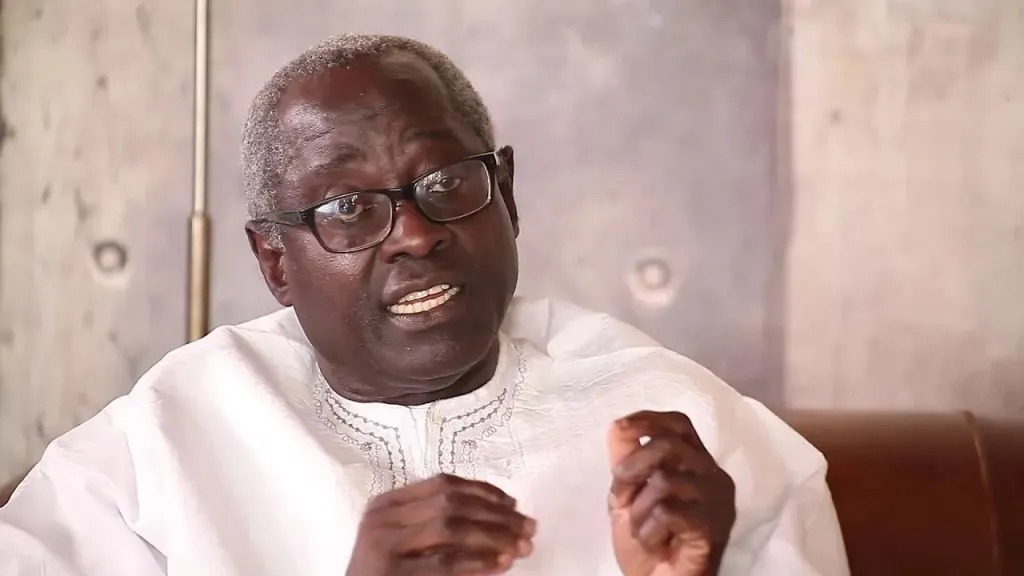
Parties affiliated with the ruling National People’s Party (NPP) have been accused by Halifa Sallah, Secretary General of the People’s Democratic Organization for Independence and Socialism (PDOIS), of losing their independence and essentially submitting to the party’s power.
Given that certain opposition parties joined the administration after the NPP alliance came to power, Sallah was asked in an interview on Coffee Time With Peter Gomez if they could be in a better position to effect change from within the government.
“Well, you must evaluate what happened to those who went in and what they are today. Obviously, they are marginalized; they do not have parties anymore. Look at those parties that say that they are part of the coalition,” Sallah said.
He emphasized that becoming a member of a government means taking on common responsibility and cautioned that people cannot separate themselves from a government’s failures. “You cannot just join a government that way and then depart. Whatever is wrong with that government, you have been a part of it,” he noted.
Sallah specifically cited the National Reconciliation Party (NRP), National Convention Party (NCP), and Gambia Party for Democracy and Progress (GPDP), claiming that the ruling party is in control of the alliance and that these parties have been reduced to NPP underlings. “So NPP is supreme to their coalition,” He said.
However, he later apologized for naming the parties, saying that PDOIS should not comment on the actions of other political organizations. “I should not have mentioned them, and I apologize for mentioning them. It is not fair. What is important is to focus on our party. Our party’s trajectory is to change the country, and to change a country requires that you have your principles,” Sallah said.
He emphasized the tenets of PDOIS, which are contained in its manifesto and constitution. Sallah underlined that all citizens should gain from national development, and that funds should be set aside to encourage productivity rather than only welfare based on consumption.
“If you look at the government budget this year, the ministry for those people who are in vulnerable groups they have allocated D200 million. Divide D200 million by half the population who are living in absolute poverty, they will end up with D200,” he said.
Sallah also pointed to the high rate of informal employment in the country. “Look at the statistics; it is telling us 81 percent of the population that is productive is in the informal sector. Not in a formal sector, not in industry, not in government. So people are just moving from hand to mouth, so that is the type of economy we have,” he said.