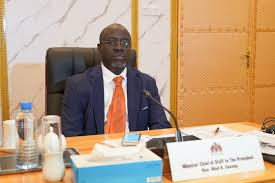
Following our previous article on the sudden fall from favour of former Chief of Staff Mod K. Ceesay, Open Gambia Platform has received further information from highly placed sources within the Barrow administration. These revelations provide a detailed account of how Mr Ceesay cultivated his relationship with President Adama Barrow and First Lady Fatoumata Bah Barrow, ultimately becoming one of the most trusted enablers in what insiders describe as a well-coordinated system of corruption that operated at the highest levels of the state.
Our earlier report noted that President Barrow blamed Mr Ceesay for allegedly misleading him into taking illegal actions, particularly in the attempted removal of Auditor General Modou Ceesay. This action has since plunged the government into an embarrassing and costly legal battle before the Supreme Court. However, insiders now argue that this narrative is a deliberate attempt by the President to distance himself from a corrupt system he actively presided over and benefited from.
“I Read It in the Papers, A Claim That Defies the Record.
One of the most striking claims attributed to President Barrow is that he was largely unaware of corruption within his administration until he read about it in the press. According to our source, this assertion is not only implausible but contradicted by the President’s own pattern of conduct.
The insider points to a consistent trend wherein individuals perceived as obstacles to corruption were swiftly removed from office, while those repeatedly accused of facilitating corruption were protected or promoted. Among those removed are:
• Mohammed Manjang, former Managing Director of SSHFC
• Bakary Jammeh, former Governor of the Central Bank
• Alpha Robinson, former Managing Director of NAWEC
• Modou Ceesay, Auditor General
In each case, they were replaced by individuals considered more compliant with presidential directives or more accommodating of alleged corrupt practices. Meanwhile, the Barrow administration has rarely acted decisively on major audit reports or corruption allegations. Against this backdrop, the President’s claim of ignorance appears increasingly untenable, especially given the dramatic changes in the lifestyles of those within his inner circle.
The Making of a Trusted Enabler
According to the insider, the story of Mod K. Ceesay is inseparable from the story of corruption under the Barrow administration.
1. Ministry of Energy and Petroleum (2017)
Mr Ceesay’s rise began with his reinstatement as Permanent Secretary at the Ministry of Energy and Petroleum. There, he allegedly played a central role in structuring and manipulating power purchase agreements involving NAWEC, Karpowership, and SENELEC. These agreements are said to have generated millions of dollars in kickbacks for President Barrow and his cabal, while leaving NAWEC financially crippled. Today, NAWEC reportedly owes the Central Bank approximately $19.4 million, a burden ultimately transferred to the Gambian taxpayer. Open Gambia Platform will publish detailed documentation of these allegations in subsequent reports.
2. Ministry of Finance and Economic Affairs
Following his “success” in the energy sector, Mr Ceesay was transferred to the Ministry of Finance and Economic Affairs. The move, according to the source, was a reward and a strategic placement, allowing him to consolidate financial control further and protect the proceeds of these arrangements.
3. Ministry of Works and the OIC Projects
After internal clashes with senior officials, including Mambury Njie and Lamin Camara, Mr Ceesay was reassigned as Permanent Secretary at the Ministry of Works, Infrastructure and Transportation, just as major OIC-funded projects were being unveiled. Insiders allege he was tasked with facilitating contract signings designed to sustain the kickback network. To clear the path, President Barrow allegedly forced the resignation of key figures, including Lamin Sanneh and Nyang Njie, from the OIC project leadership.
4. Promotion to Chief of Staff and Minister for Presidential Affairs
Having successfully managed what the insider describes as the largest corruption schemes under the administration, Mr Ceesay was elevated to the Cabinet. President Barrow created a powerful “super ministry,” appointing himself Minister for Presidential Affairs and Chief of Staff. This role gave Mr Ceesay sweeping authority over the entire administration, while also allowing him to control access to the President.
Power, Enemies, and the Beginning of the End
Mr Ceesay’s newfound power soon became a liability. According to the source, he began issuing directives directly to ministers, claiming they came from the President. Contractors and investors were increasingly instructed to channel all dealings through the Chief of Staff. This arrangement alienated influential figures, including Infrastructure Minister Ebrima Sillah, Fisheries Minister Musa Drammeh, Chief of Protocol Alhagie Ousman Ceesay, and Local Government Minister Ahmat Bah, who felt their authority was being systematically undermined.
Nevertheless, most ministers, heads of departments, and state-owned enterprises complied, seeing loyalty to the Chief of Staff as essential for job security.
The Auditor General Crisis
The turning point came when Mr Ceesay allegedly attempted to pressure Auditor General Modou Ceesay, a longtime friend, to manipulate or delay the 2021, 2022, 2023, and 2024 National Audit Reports, which insiders say contain highly damaging findings against the Barrow administration. According to the source, the objective was to delay publication until after the presidential election.
The conflict escalated when the Auditor General reportedly refused to comply with illegal requests, including demands related to accessing the GRA database. This action could have exposed billions of Dalasis in allegedly diverted tax revenues. When persuasion failed, Mr Ceesay is said to have coordinated with Attorney General Dawda Jallow to orchestrate the illegal and forceful removal of the Auditor General.
This move backfired spectacularly. The government now faces legal action at the Supreme Court and, fearing defeat, has reportedly used public funds to hire private legal counsel to defend its position.
Abandonment and Scapegoating
With the administration engulfed in crisis, rival ministers and political actors moved swiftly. Sensing weakness, they presented evidence implicating Mr Ceesay in corrupt dealings, including allegations involving AREZKI Construction Company, a major state contractor said to have built a private mansion for him. They argued that far from being loyal, Mr Ceesay had been diverting kickbacks for personal gain.
Faced with mounting pressure, President Barrow moved to sideline his once-trusted enabler. Mr Ceesay’s duties were delegated to his deputy, who later replaced him as Chief of Staff, while Mr Ceesay was reassigned to the Ministry of Trade, marking a dramatic fall from power.
Your support means the world to us! Please follow our page to keep up with our latest posts, and don’t forget to hit that like button and share our content with your friends. Thank you for being a part of the OPEN GAMBIA PLATFORM community! Anon on 22 December 2025! Views expressed by contributors are strictly personal and not of TheOpenGambiaPlatform!
You can now write for the Open Gambia Platform, share information anonymously, and join the community. Please share your stories!
By Open Gambia Platform