
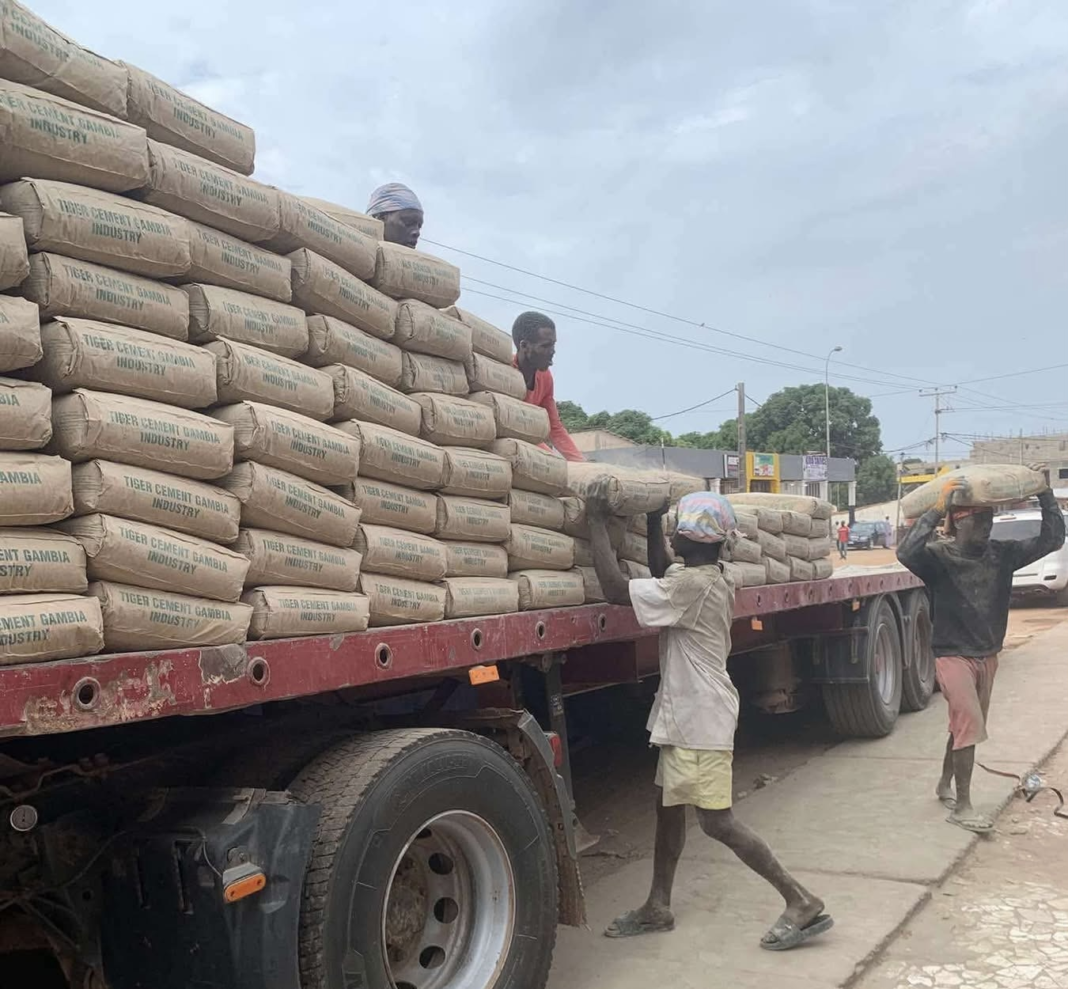

Market prices are still remarkably high one week after the Gambia government repealed the ban on cross-border cement imports that was put in place last year to safeguard domestic producers. This has angered the public and reignited discussions about competition and regulation in the building industry.
The government criticized the tariff on imported bagged cement in April 2024, saying it was a patriotic step to “protect local production” and encourage industrialization. The tax was raised from D30 to D180 each bag.
The reform increased the overall tax burden from roughly D30 to D180 per 50 kg bag by adding a D3 per kilogram tariff on imported cement. Critics accused the government of giving monopolies to a select few operators, which caused a great deal of outcry.
However, following months of price volatility and supply shortages, the Ministry of Trade said last week that the maratorium would be lifted, citing the need to “stabilize supply and ensure fair market access.”
Following discussions with regional importers, manufacturers, and consumer advocacy organizations, who expressed concern that the limitation was causing inflation and delaying building projects across the country, the decision was made.
Despite the legislative change, a bag of cement still costs between D500 and D625 in the majority of the country, which is only marginally less than the peak prices observed when the ban was first implemented in the middle of 2024.
The larger issue of unchecked profiteering and a regulatory structure that fails to safeguard consumers has been brought to light by the removal of the D180 tax.
Economist Ebrima Ceesay contended that while lifting the embargo is a start in the right direction, cement prices would continue to rise unless dishonest companies are held accountable for their price increases and logistical efficiency is improved.
“Cement has been used as a license to print money by powerful importers, bulk distributors, and retailers, who have added absurd margins just because they can.
According to Ceesay, the government must guarantee that cement prices are reasonable and accessible to all Gambians.
He stated that in order to control the cement market and safeguard customers, the Ministry of Trade, the Gambia Revenue Authority, and the Ministry of Finance must cooperate.
“The government should impose conditional pricing controls tied to any future concessions. The Gambia Revenue Authority should strengthen valuation verification and ensure that waived imports are transparently tracked and audited,” he said.
The Ministry of Trade should enforce fair pricing and quality standards in the market, according to Farafenni-based mason Dodou Saho.
“It is also important to note that the quality of cement being imported from Senegal is substandard. The 32.5R cement is widely considered to be of lower quality and is not even preferred in Senegal. Gambians deserve better quality cement for their construction projects,” Saho said.
In order to address the unwarranted price increase and guarantee that cement costs are reasonable and accessible to all Gambians, he said the government must act right away.
“The people of The Gambia deserve a government that protects their interests and promotes economic development.”