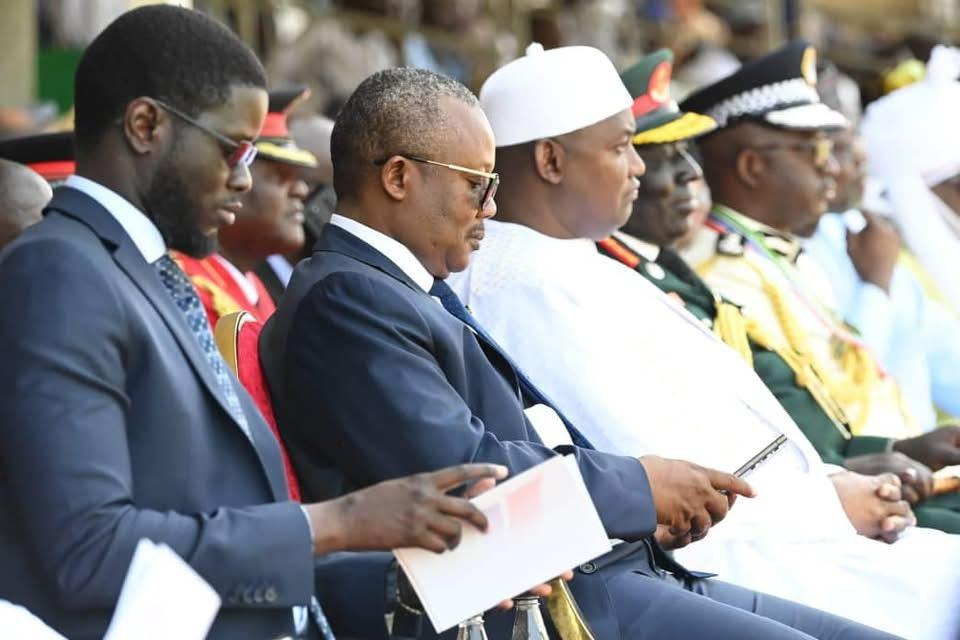
President Adama Barrow’s decision to seat Guinea-Bissau’s President Umaro Sissoco Embaló next to him during the diamond jubilee celebrations of The Gambia’s 60th independence has raised eyebrows. In contrast, Senegal’s President, a propitious democratic leader, was kept at a distance. Even more striking was Barrow’s choice to acknowledge President Embaló before President Bassirou Diomaye Faye in his speech, disregarding alphabetical and diplomatic protocol. Many political observers view this as a breach of protocol, considering the deep historical and political ties between The Gambia and Senegal.
In Guinea-Bissau, presidential elections were initially scheduled for December 2024, ahead of President Embaló’s term ending on February 27, 2025. However, after dissolving Parliament in December 2023 and cancelling the planned parliamentary elections, Embaló also postponed the presidential elections. They are now expected to take place in November 2025. If he remains in office beyond his mandate, he would be violating Guinea-Bissau’s constitution and effectively occupying power illegally.
President Embaló has repeatedly manipulated the constitution by dissolving the opposition-led Parliament without arranging fresh elections. ECOWAS, the regional body, has failed to hold him accountable for his abuse of power, which endangers Guinea-Bissau’s democratic governance, stability, and the credibility of ECOWAS itself.
President Barrow appears to be following the same playbook as ECOWAS’ so-called “Old Boys Club” by pursuing a third term. He has maintained his political alliance with former Senegalese President Macky Sall and now aligns with President Embaló, who seems determined to cling to power out of fear of facing accountability once they leave office.
Gambian opposition parties must carefully monitor the unfolding political situation in Guinea-Bissau. President Embaló is replicating the same authoritarian tactics his mentor, Macky Sall, unsuccessfully attempted in Senegal. Similarly, Barrow is adopting this approach. It is worth recalling that after Macky Sall falsely accused opposition groups of terrorism of justifying banning the Pastef party, Barrow’s government attempted a similar manoeuvre. His administration orchestrated a security scare by shutting down the Police Intervention Unit (PIU) office and trying to blame the United Democratic Party (UDP) and its prominent leader, Chairman Yanks Darboe, as a pretext for banning the UDP.
Why is President Barrow distancing himself from President Faye? Is it due to guilt over how his administration treated Faye’s party while they were in opposition? Does he fear that Faye, now in power, possesses intelligence files exposing Barrow’s dealings with Macky Sall, including potential financial malpractice and money laundering in Senegal?
Furthermore, is Barrow uneasy with the rise of the Pastef party in Senegal? Given their experience in opposition and their Pan-African ideology, Pastef is unlikely to support any dubious political manoeuvres against the Gambian opposition—unlike their predecessor, Macky Sall.
Gambians must heed: President Barrow has crossed a red line by declaring his intention to seek a third term. If unchecked, he will continue to do whatever it takes to hold onto power, driven by his fear of facing accountability after leaving office.
Your support means the world to us! Please follow our page to keep up with our latest posts, and don’t forget to hit that like button and share our content with your friends. Thank you for being a part of the OPEN GAMBIA PLATFORM community! Article contributed by Anon on 20th February 2025! Views expressed by contributors are strictly personal and not of TheOpenGambiaPlatform!
You can now write for the Open Gambia Platform, share information anonymously, and join the community. Please share your stories!